


The ESP32-P4 development board ESP32-P4 and ESP32-C6 Wi-Fi 6 and Bluetooth 5/BLE 5 supporting Xiaozhi AI DeepSeek
Pickup available at Digilog Electronics
Usually ready in 2 hours

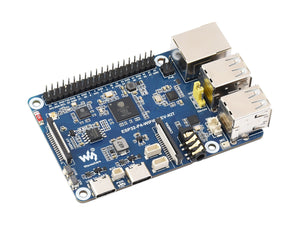
The ESP32-P4 development board is a high-performance development board based on the ESP32-P4 and ESP32-C6, supporting Wi-Fi 6 and Bluetooth 5/BLE 5, and also supporting Xiaozhi AI DeepSeek.
ESP32-P4-WIFI6-DEV-KIT
Development Board
High-performance development boards based on ESP32-P4 and ESP32-C6
Rich human-computer interaction interfaces

Development Board Introduction
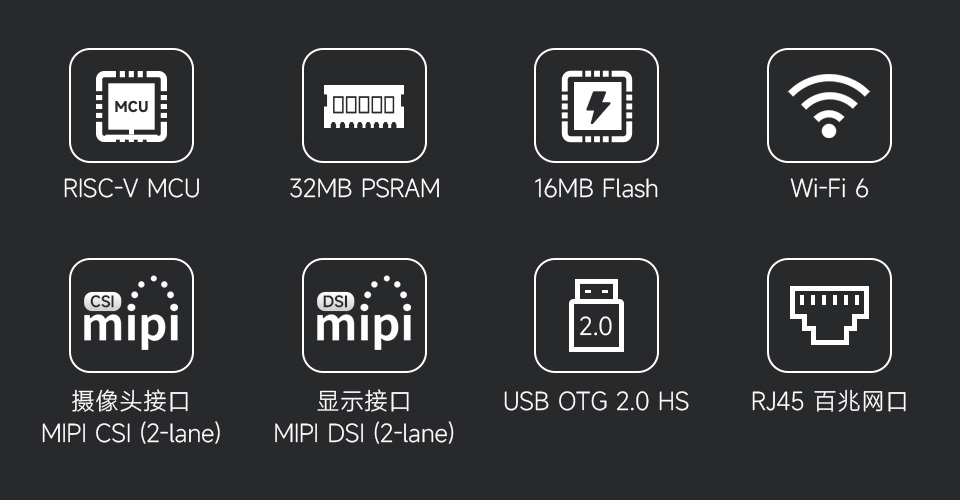
This product is a high-performance RISC-V development board based on the ESP32-P4, featuring a dual-core processor and a single-core chip. It supports a rich set of human-machine interfaces, including MIPI-CSI (Integrated Image Signal Processor) and MIPI-DSI interfaces. It also supports common peripherals such as SPI, I2S, I2C, LED PWM, MCPWM, RMT, ADC, UART, and TWAI. Furthermore, it supports USB OTG 2.0 HS, Ethernet, and SDIO Host 3.0 for high-speed connectivity. The ESP32-P4 chip integrates a digital signature peripheral and a dedicated key management unit to ensure data and operational security. The ESP32-P4-WIFI6-DEV-KIT is designed for high-performance and high-security applications, fully meeting the higher demands of embedded applications for human-machine interface support, edge computing capabilities, and I/O connectivity.
Key features:
- High-performance MCUs equipped with RISC-V 32-bit dual-core and single-core processors
- 128KB HP ROM, 16KB LP ROM, 768KB HP L2MEM, 32KB LP SRAM, 8KB TCM
- It boasts powerful image and audio processing capabilities, with interfaces including a JPEG codec, a pixel processing accelerator (PPA), an image signal processor (ISP), and an H.264 video encoder.
- The chip package contains 32MB of PSRAM, and the module integrates 16MB of Nor Flash.
- The board features common peripheral interfaces such as MIPI-CSI, MIPI-DSI, USB 2.0 OTG, Ethernet, SDIO 3.0 SD card slot, microphone, speaker terminals, and RTC battery terminals.
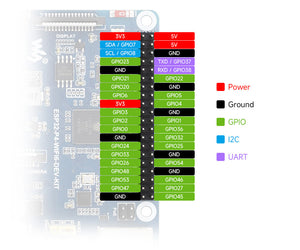
- The board has 2 × 20 pin headers, providing 28 additional programmable GPIO pins.
- Security mechanisms include Secure Boot, Flash encryption, a hardware encryption accelerator, and a hardware random number generator. It also supports hardware access protection, enabling Access Management (APM) and permission separation.
Images are for illustrative purposes only; please refer to the configuration list for detailed specifications.
Highly integrated and powerful performance
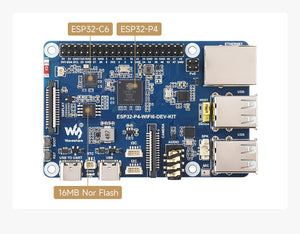
The development board uses the ESP32-P4 chip, with an onboard ESP32-C6 and 16MB Nor Flash memory.

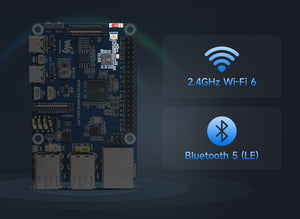
Supports Wi-Fi 6 and Bluetooth modules.
The onboard ESP32-C6 chip extends the ESP32-P4-WIFI6-DEV-KIT with 2.4GHz Wi-Fi 6 and Bluetooth 5 (LE),
using the SDIO interface protocol for communication, ensuring stable connection and efficient transmission.

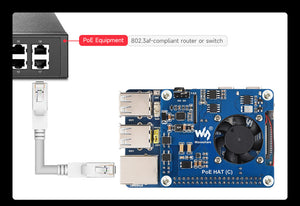
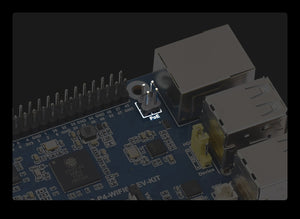
Reserved PoE module interface
This makes the power supply method of the development board more flexible.

Using a PoE module
PoE (Power over Ethernet) can be implemented.
With just one network cable connected to the PoE device,
the ESP32-P4-WIFI6-DEV-KIT can achieve both network connectivity and power supply.

This product does not include a PoE expansion module , which must be purchased separately; please refer to the configuration list for detailed configuration.
Supports AI voice interaction
Supports mainstream AI platforms and can connect to online large model platforms such as Doubao and DeepSeek.

(Development board packages B and C only include a screen)
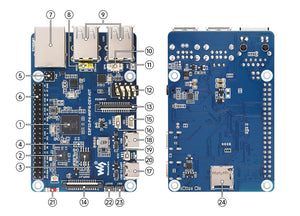
Resource Introduction

-
ESP32-P4NRW32
ESP32-P4 with 32MB PSRAM
-
ESP32-C6
SDIO interface protocol, extending the ESP32-P4's Wi-Fi 6 and Bluetooth 5 (LE) capabilities.
- 16MB Nor Flash
- ESP32-C6 UART pads
-
PoE Module Interface
It can be connected to an external PoE module for PoE power supply.
- 40PIN terminal
- 100Mbps RJ45 network port
-
USB OTG function switch header
The number of USB ports can be expanded by switching the host.
-
USB-A interface
USB OTG 2.0 High Speed interface, function can be switched via jumper cap.
-
Speaker Interface
MX1.25 2P connector, supports 8Ω 2W speakers
- Patch microphone
-
3.5mm headphone jack
Can connect headphones to play sound
-
Camera interface
MIPI-CSI (2-lane) can connect to cameras such as the OV5647.
-
Display Interface
The MIPI-DSI (2-lane) can connect to 5 / 7 / 8 / 10.1- inch DSI screens.
- I2C interface
- I3C interface
-
Type-C UART interface
It can be used for power supply, program burning, and debugging.
-
Type-C USB interface
It can be used for power supply and program burning.
-
RTC socket
Connect a rechargeable RTC battery (only rechargeable RTC batteries are supported)
-
PWR
Power indicator light
- ESP32-C6 Patch Antenna
-
BOOT button
Press the button during power-on or reset to enter download mode.
-
RST button
Reset button
-
SD card slot
SDIO 3.0 Interface Protocol
Pin Definitions

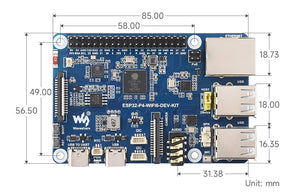
Product Dimensions

