


Raspberry Pi Pico 2 RP2350 Microcontroller Development Board – 520 KB SRAM, 4 MB Flash
Pickup available at Digilog Electronics
Usually ready in 2 hours

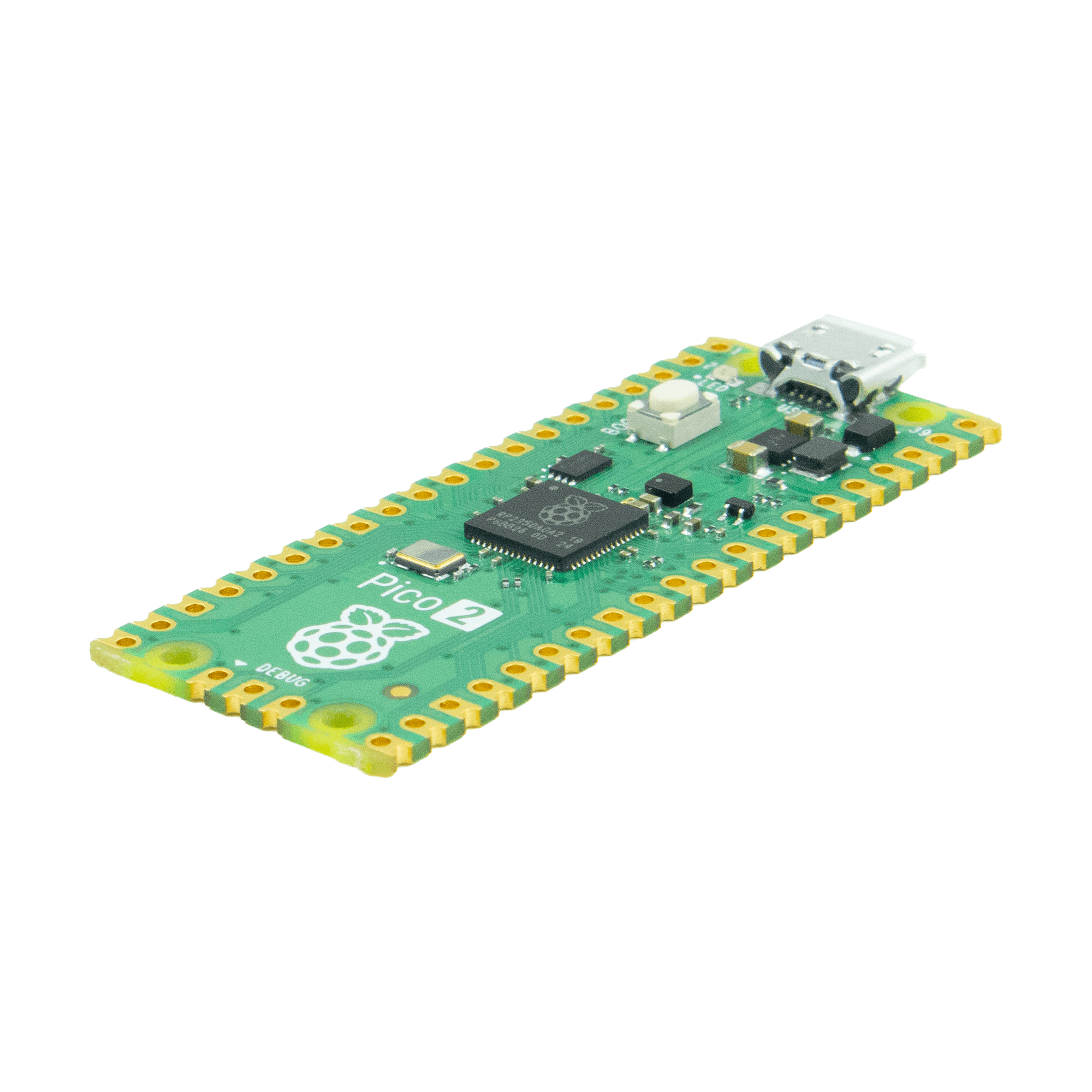
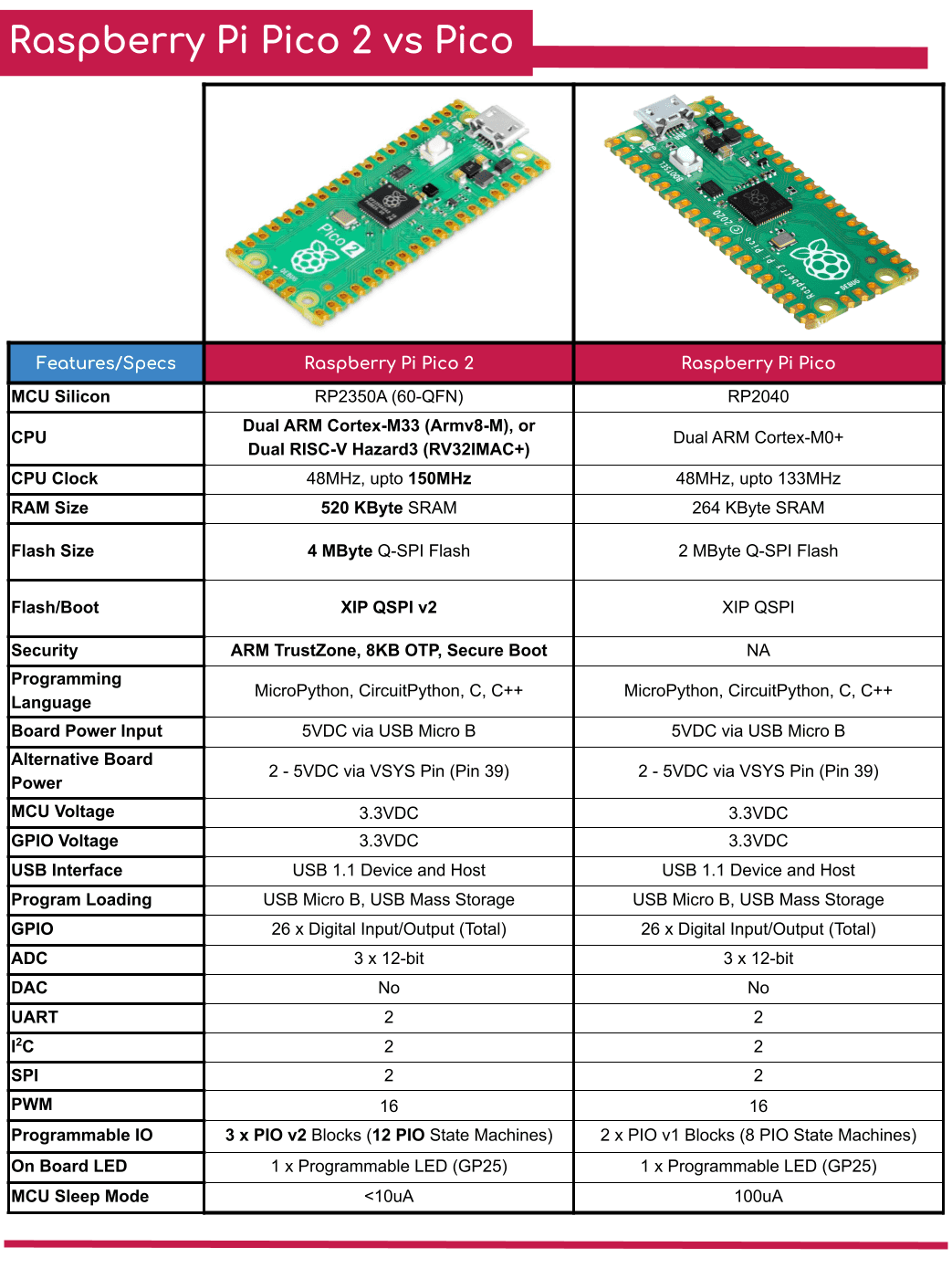
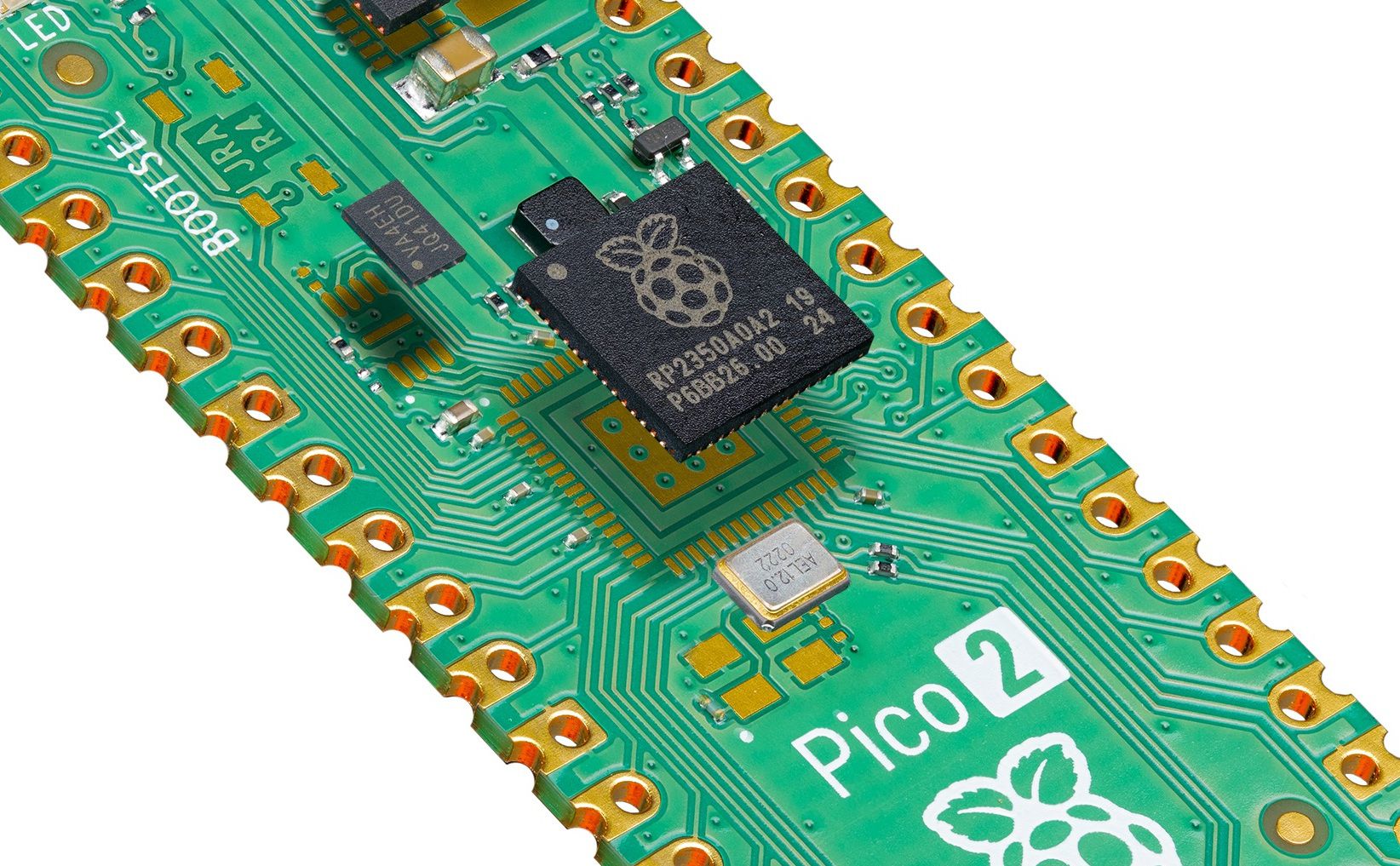
The Raspberry Pi Pico 2 is the RP2350-powered successor to the original Pico, and it keeps everything that made the first board easy to live with — the 51 × 21 mm DIP footprint, the 40-pin breadboard-friendly layout, drag-and-drop USB flashing — while roughly doubling the compute underneath. Two Arm Cortex-M33 cores or two Hazard3 RISC-V cores (selectable at boot) run at up to 150 MHz, backed by 520 KB of on-chip SRAM and 4 MB of onboard QSPI flash.
That extra headroom is what you feel in practice: larger MicroPython programs, deeper sensor buffers, floating-point and DSP maths that used to be out of reach, and several PIO-driven interfaces running at the same time. Existing Pico projects and add-on boards carry straight over, so you can move a working build onto this RP2350 microcontroller board without redesigning your wiring.
Key Features
- ⚡ Dual-core, dual-architecture RP2350A — run two Arm Cortex-M33 cores or two Hazard3 RISC-V cores at up to 150 MHz, with an on-chip PLL for variable core frequency.
- 🧠 520 KB SRAM + 4 MB QSPI flash — nearly double the original Pico on both counts, with a 16 KB XIP cache so code runs from flash without stalling.
- 🔧 26 multi-function GPIO — 2 × UART, 2 × SPI, 2 × I2C, 16 PWM channels and 3 ADC inputs fed by a 12-bit 500 ksps converter. All IO is fixed at 3.3 V.
- 🎛️ 12 PIO state machines — three programmable IO blocks that let you build interfaces the chip has no dedicated peripheral for, such as SD card, VGA or addressable LED strips.
- 🔒 Hardware security block — Arm TrustZone for Cortex-M, signed boot, 8 KB of antifuse OTP for key storage, SHA-256 acceleration, a hardware TRNG and fast glitch detectors.
- 🔋 Flexible 1.8–5.5 V supply — an on-board buck-boost SMPS runs the board from micro-USB, a single Li-ion cell or 3 × AA in series, so battery projects need no extra regulator.
- 📏 Breadboard or surface-mount — 51 × 21 mm, 1 mm thick PCB on a 2.54 mm (0.1″) grid, with castellated edges so the same board can be reflow-soldered as a module.
- 🛠️ Easy to program and debug — drag-and-drop UF2 over micro-USB, plus a 3-pin ARM Serial Wire Debug (SWD) header for real breakpoint debugging.
- ✅ C/C++ and MicroPython — a mature SDK, thousands of examples and full documentation, backed by production until at least January 2040.
Specifications
| Microcontroller | Raspberry Pi RP2350A |
| CPU cores | Dual Arm Cortex-M33 or dual Hazard3 RISC-V (selectable) |
| Clock speed | Up to 150 MHz (on-chip PLL, variable) |
| SRAM | 520 KB multi-bank on-chip |
| Flash | 4 MB external QSPI (Winbond W25Q32RV) with XIP + 16 KB cache |
| GPIO | 26 multi-function 3.3 V GPIO (3 usable as ADC inputs) |
| ADC | 12-bit, 500 ksps |
| Serial interfaces | 2 × UART, 2 × SPI, 2 × I2C |
| PWM | 16 channels |
| PIO | 3 blocks, 12 state machines total |
| Timers | 2 × timer with 4 alarms, 1 × always-on (AON) timer |
| USB | USB 1.1 controller and PHY, host or device; micro-USB B connector |
| Debug | 3-pin ARM Serial Wire Debug (SWD) port |
| Security | Arm TrustZone, signed boot, 8 KB antifuse OTP, SHA-256 accelerator, TRNG, glitch detectors |
| Input voltage | 1.8–5.5 V DC (buck-boost SMPS) |
| Dimensions | 51 × 21 mm, 1 mm thick PCB; 40 pins on 2.54 mm pitch; 4 × 2.1 mm mounting holes |
| Operating temperature | −20 °C to +85 °C |
| Programming | C/C++ SDK, MicroPython, Arduino IDE |
What's in the Box
- 1 × Raspberry Pi Pico 2 (RP2350) microcontroller board
Supplied as a bare board — pin headers are not pre-soldered, and no USB cable is included.
Typical Applications
- IoT nodes, data loggers and smart-home controllers
- Robotics, motor control and line-following projects
- Multi-sensor acquisition over I2C, SPI and analogue inputs
- Custom digital interfaces built on PIO (LED strips, SD card, VGA)
- University lab work, FYPs and embedded-systems teaching
Who It's For
Students and hobbyists get an inexpensive first microcontroller with the friendliest MicroPython on-ramp available; university and FYP teams get enough SRAM and floating-point performance for real signal processing; and product developers get a chip with TrustZone, signed boot and a guaranteed supply window to prototype against before committing to a custom RP2350 design.
The Raspberry Pi Pico 2 RP2350 microcontroller board is available at Digilog.pk with nationwide delivery across Pakistan. Order yours today and start building.
The Highlights:

The New MCU Series by Raspberry Pi
Compact and Ready to be Mounted into the Product