


DIY Router Power Bank Parts With 3 Cells
Pickup available at Digilog Electronics
Usually ready in 2 hours

What's included


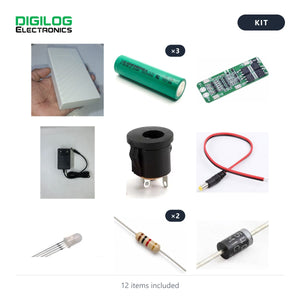
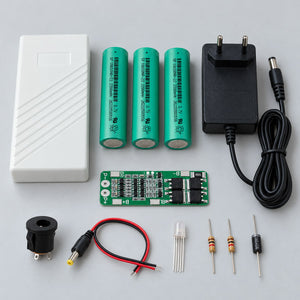
Build your own rechargeable battery backup for a compatible Wi-Fi router or other DC-powered device with this DIY assembly kit. It includes three SF 18650NR-22 rechargeable lithium-ion cells, a 3S battery protection board, a compatible charging adapter, and essential connectors and components for DIY assembly.
Package Includes
- 1 × 18650/21700 power bank case (verify secure fit for 3 cells)
- 3 × SF 18650NR-22 Li-ion 18650 rechargeable battery cells (3.7V, 2200mAh each)
- 1 × 3S 20A Li-ion battery BMS protection board
- 1 × 12.6V 2A DC power adapter with EU plug and barrel jack
- 1 × DC-022 panel-mount female DC socket (5.5mm × 2.1mm)
- 1 × DC male power connector with wire lead
- 1 × Common-cathode 5mm diffused RGB LED
- 2 × 1kΩ, ¼-watt (0.25W), 5% tolerance resistors
- 1 × 1N5408 power diode
Battery Specifications
- Battery configuration: 3S1P (three cells in series)
- Nominal pack voltage: 11.1V
- Fully charged voltage: 12.6V
- Battery capacity: 2200mAh (2.2Ah)
- Nominal battery energy: approximately 24.42Wh
- Battery chemistry: Lithium-ion (Li-ion)
DIY Applications
Suitable for electronics enthusiasts who want to assemble a rechargeable backup power supply for compatible Wi-Fi routers and other DC-powered devices. The included connectors provide connection points for charging and powering the device, while the RGB LED can be used in a custom indicator circuit.
Important Compatibility and Safety Notes
This is a DIY component kit, not an assembled or ready-to-use router UPS. Wiring, assembly, and testing are required.
- Verify the router's required voltage, current, connector size, and polarity before connecting it.
- A 3S Li-ion pack reaches 12.6V when fully charged. The listed components do not include a confirmed output voltage regulator.
- Confirm that the case securely accommodates three cells and prevents movement or short circuits.
- Use a compatible 3S BMS and charging arrangement. Verify that the adapter is suitable for the actual charging circuit before use.
- Confirm the LED wiring and resistor values against the intended circuit.
- Lithium-ion battery assembly requires proper insulation and protection against short circuits.
Note: Actual backup time depends on the router's power consumption, battery condition, and circuit efficiency.